[T] Handshake Lemma (T1.1)
For any graph , the sum of the degrees of its vertices is twice the number of its edges:
where is the degree of vertex : the number of edges incident with , each loop counting as two edges.
The name comes from the picture of people at a party shaking hands: every handshake involves exactly two hands, so the total number of hands shaken is twice the number of handshakes.
Proof
Uses counting in two ways on the incidence matrix of , the matrix where is the number of times (0, 1 or 2) that vertex and edge are incident.
Row sums: the row of vertex sums to exactly , so the sum of all entries of is .
Column sums: every edge has two ends, so each of the columns sums to , and the sum of all entries of is .
Equating the two:
Example
A graph with vertices and edges, where is a loop at (shown in red):
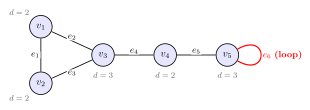
Its incidence matrix, with the row sums on the right and the column sums along the bottom:
Each row sums to the degree of its vertex: .
Each column sums to , because every edge has two ends: .
The loop: has both ends at , so its whole column sum of sits in one cell (). This is why a loop adds to the degree; otherwise the identity would fail.
[C] Number of odd-degree vertices is even (C1.2)
In any graph, the number of vertices of odd degree is even.
Proof
Consider the handshake identity modulo 2. Each term satisfies
So modulo 2 the left-hand side is congruent to the number of odd-degree vertices, while the right-hand side . Hence the number of odd-degree vertices is , i.e. even.
In the example above, the odd-degree vertices are and (both have degree ). That is of them, an even number.
Consequences
The average degree .
A -regular graph on vertices has edges, so must be even (e.g. there is no 3-regular graph on an odd number of vertices).